

Reverse Engineering
Reverse engineering is the process of accurately capturing the geometry of a physical object to create a digital 3D model. This service is essential for recreating parts when original designs are unavailable, enhancing existing products, or developing innovative solutions based on existing components.
At Laser Scanning, we use cutting-edge scanning technology to provide highly accurate digital representations of physical objects. Whether you’re looking to reproduce obsolete parts, improve product performance, or conduct competitive analysis, our reverse engineering services offer precise and reliable results tailored to your needs.
What is reverse engineering?
Reverse engineering using laser scanning involves capturing the precise shape and geometry of a physical object and converting it into a digital 3D model. This method is especially useful when original design data is unavailable, damaged, or lost. Laser scanning allows us to quickly and accurately create a detailed, high-resolution model of any part or component, whether it’s a simple shape or a highly complex assembly.
1.
Data Capture
Our process begins with the capture of detailed 3D data using advanced laser scanning technology. This non-contact method provides highly accurate measurements of the object’s surface, including complex geometries, fine details, and intricate features. The data collected is the foundation for creating a high-resolution digital model.
2.
Data Processing
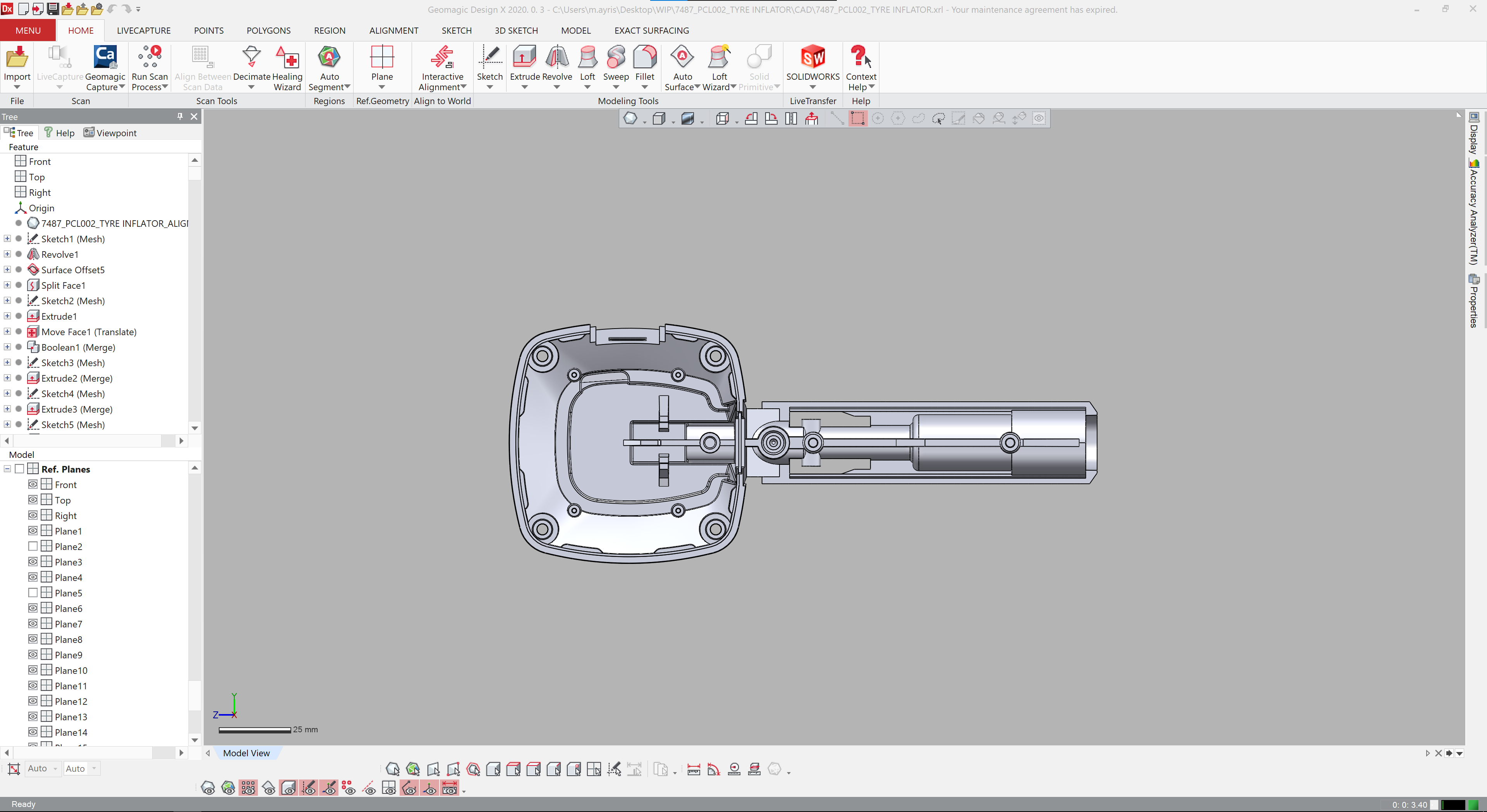
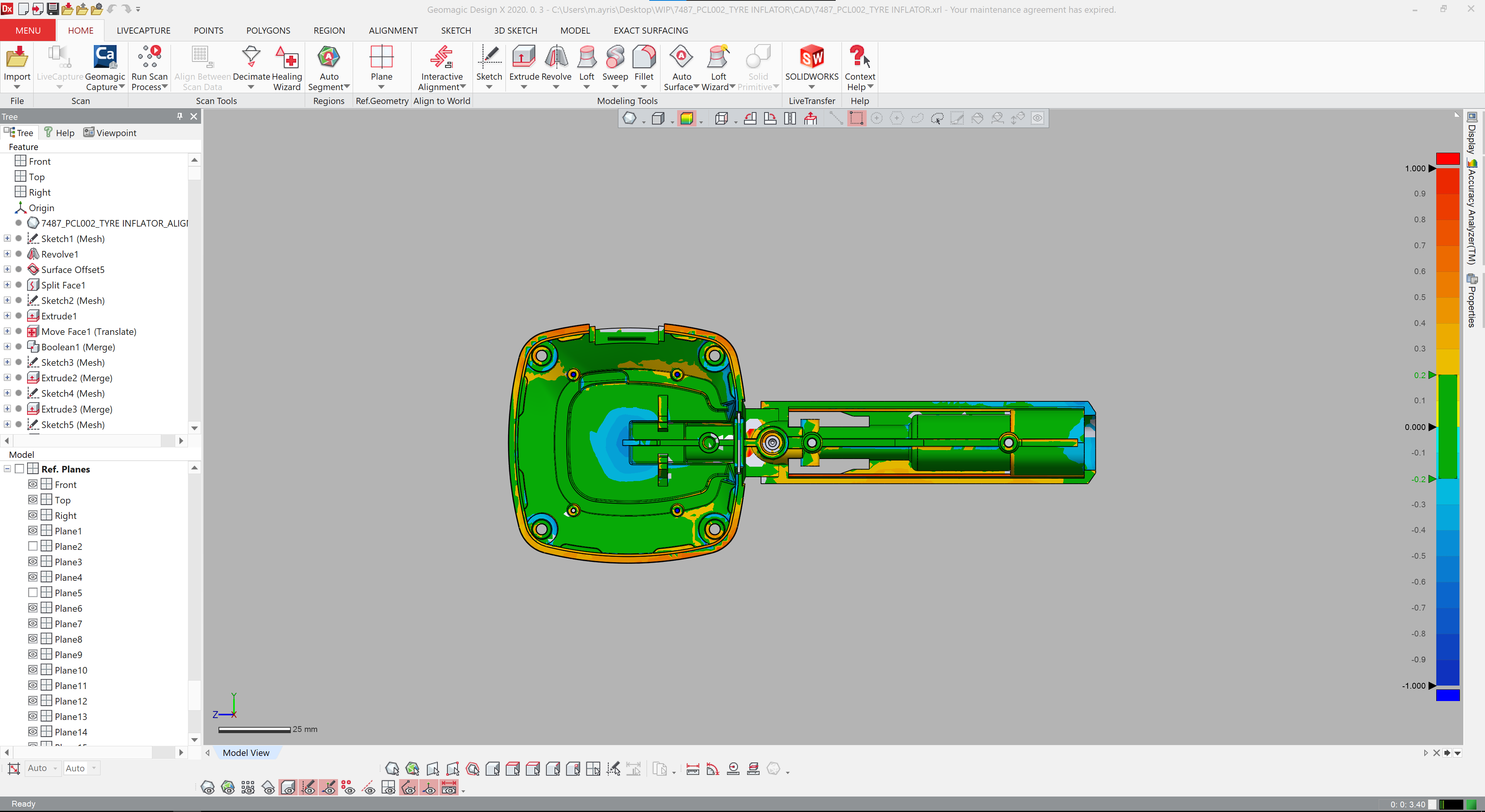
After scanning, the point cloud data is processed into a mesh STL file. This file is aligned to a global coordinate system to ensure accuracy across all dimensions. Our processing step ensures the data is optimized for the next stages, enabling precise reconstruction of the part.
3.
Reverse Engineer
Using the processed mesh, we reverse engineer the part to recover its original design intent. Through parametric modeling, we restore the part’s functionality and specifications, ensuring that the digital model reflects the exact requirements for manufacturing or modification. This model is fully suitable for production, and we can provide detailed technical drawings if required to support the manufacturing process, ensuring precision and quality during production.
4.
Prototyping
Prototyping is an optional but highly recommended step if you’re planning to proceed with further manufacturing, especially if you’re investing in an expensive tool or production process. A prototype allows you to validate the design, ensure functionality, and make any necessary adjustments before committing to full-scale production. This step can save time and cost in the long run by identifying potential issues early in the process.
5.
Manufacture
Once you are satisfied with the final design, the part is ready to move into the manufacturing process, should that be the desired outcome of your project. While we do not handle mass production in-house, we have a trusted network of partners for both batch and mass production, ensuring the design can be accurately realized at scale.
Key Benefits.
- Design Recovery: Reconstruct lost or outdated design documentation for existing parts.
- Part Improvement: Identify opportunities to improve or optimize the design of a part or product.
- Quality Control: Ensure that manufactured parts meet original design specifications through detailed analysis and comparison.
- Replacement and Maintenance: Create accurate replicas of worn or damaged parts, especially when original manufacturers are no longer available.
- Integration with Modern Technology: Adapt older parts to integrate with newer systems or technologies.
- Cost Efficiency: Reduce costs by analyzing existing products for more economical manufacturing processes.
- Customization: Modify and customize parts to meet specific needs or applications.
- Innovation: Drive innovation by understanding competitors’ products or integrating multiple designs into a new, improved product.
- Time-Saving: Speed up the development process by using existing parts as a foundation rather than starting from scratch.
- Accuracy: Achieve high levels of accuracy in reproducing complex geometries through advanced scanning and modeling techniques.
Applications.
- Aerospace:
- Reverse engineering of complex turbine components for maintenance and upgrades.
- Automotive:
- Re-creating obsolete parts for vintage or custom vehicles.
- Medical Devices:
- Developing prototypes for custom surgical instruments or prosthetics.
- Consumer Electronics:
- Improving or modifying existing product designs for better performance.
- Manufacturing and Industrial Equipment:
- Reverse engineering machinery parts that are no longer produced.
- Marine:
- Reproducing parts for aging ships or boats that require maintenance.
- Architecture and Construction:
- Restoring or recreating detailed architectural features.
- Tool and Die Making:
- Rebuilding or modifying molds, dies, and tools for manufacturing.
Something on Reverse Engineering
Reverse engineering offers a wide range of benefits to businesses across various industries. This process is not just about creating a replica of an existing part, but also about unlocking new opportunities for innovation, optimization, and cost savings.
Your browser does not support 3D model viewing. Please try a modern browser.
Let's start your project today.
Our team is ready to listen to your requirements, ask the right questions, and provide solutions that fit both your expectations and budget. Let’s bring your project to life quickly and efficiently.
FAQs
Why 3D Laser Scanning?
3D laser scanning offers a precise and cost-effective way to digitise physical prototypes, capturing the shape and dimensions of an object so that they may be used in design, inspection and visualisation processes throughout manufacture, quality inspection and prototype testing.
We can provide your bespoke 3D scanning solution. Equipped with a range of cutting-edge scanners capable of varying accuracies and capture speed, offering both CMM and portable options, here at Laser Scanning we can cater to any 3D scanning project with our industry-leading knowledge and technologically-advanced Nikon hardware.
The benefits of 3D Scanning are extensive in terms of efficiency and cost. Digitising the shape and features of a prototype using a non-contact laser scanner reduces errors, streamlines production workflows and provides a highly-accurate quality control procedure. The laser scanning process has the ability to capture tens of thousands of points per second, meaning that a complete inspection may be up to 10 times faster than tactile probing wihtout compromising on accuracy.
With the need for extensive programming and repeated scanning cycles removed, and no need for costly clamping fixtures to hold prototypes in place, 3D scanning is a more cost-effective solution than traditional measurement methods such as tactile probing too.
Laser scanning can be used for any application where you want to capture high accuracy 3D data about an object’s shape. This includes but is not limited to: automotive and aerospace design, reverse engineering and inspection, architecture, industrial design and engineering, medical visualisation and simulation, robotics and automation among many other applications.
Technical Specifications
The 3D laser scanning facilities we can offer are the most technologically advanced and accurate in the industry. Our centrally-located premises accommodates CMM 3D laser scanning equipment including the XC65Dx-LS, considered the ultimate scanner for feature inspection and capture of features, edges, pockets, ribs and freeform surfaces in a single scan on any surface.
Other onsite equipment includes the LC15Dx and the L100, two CMM scanners known to offer the best possible combination of speed and accuracy, even on multi-material surfaces that would previously present issues in laser creating part-to-CAD comparison reports.
Our capacity for portable laser scanning extends UK-wide, our specialist team highly-experienced in the use of handheld scanners including the Nikon H120, ModelMaker MMDx50, MMDx100 and MMDx200. Handheld non-contact measuring uses digital camera technology to deliver a measuring accuracy down to 7 microns, with high-frame rates and laser stripes up to 200mm, allowing freeform surfaces to be scanned accurately and efficiently.
Handheld laser scanning using Nikon Metrology ModelMaker technology is ideal for measuring soft and fragile parts onsite at your premises, removing the risk of damage, possibility of inaccurate measurements and additional costs associated with disassembling machinery and transporting individual parts.
Service Limitations
With years of expertise and a range of advanced Nikon laser scanning technology at our fingertips, we can deliver detailed non-contact 3D scanning on objects of any size and for any project. We have performed 3D scanning services for a wide range of industries, from Automotive to Aerospace, Energy, Defence, Rail, product design and animation teams, art and archaeology projects and many more.
The benefits of 3D Scanning are extensive in terms of efficiency and cost. Digitising the shape and features of a prototype using a non-contact laser scanner reduces errors, streamlines the production process and provides a highly-accurate quality control procedure.
The laser scanning process has the ability to capture tens of thousands of points per second, meaning that a complete inspection may be up to 10 times faster than tactile probing, not to mention far more accurate. With the need for extensive programming and repeated scanning cycles removed, and no need for costly clamping fixtures to hold prototypes in place, 3D scanning is a more cost-effective solution than traditional measurement methods such as tactile probing too.
The range of laser scanning technology available to us means that few 3D scanning, measuring and design requirements are beyond our capabilities.
What We Need To Know
The first stage in successful laser scanning is selecting the right laser scanner for your application. To do this, we need to gather a clear idea of what you would like to achieve, what forms require scanning and how you intend to use the information delivered by the digital inspection process.
Once we received your initial enquiry, we’ll arrange to have a chat to find out more about your 3D laser scanning needs. Once we understand what you would like to achieve, we will usually request photographs of the applicable parts or structures. From therein we will be in a position to advise on the best laser scanning solution for your individual project and which of our cutting-edge portable or CMM scanners will deliver the result you require.
At Laser Scanning we believe that communication is key and that staying in constant communication is essential in delivering a project that not only meets our customers’ expectations but exceeds them. We pride ourselves on going above and beyond to deliver results that push the boundaries of what can conventionally be achieved in precision measurement and engineering processes. We know how important it is to deliver unbeatable accuracy in often tight lead times and our specialist team makes the process effortless, however big or small your project.